Gold Corridor (Metro Line 8) Gets Approval: Navi Mumbai’s Airport-to-Airport Metro Set to Redefine Connectivity & Property Markets

Updated: Dec 4, 2025
Metro Line 8 will offer direct Airport-to-Airport connectivity, slashing travel time from over an hour to just 30 minutes
1. PROJECT OVERVIEW (SCOPE)

The Government of Maharashtra has officially approved the ambitious ₹23,000-crore Metro Line 8 (Gold Line)
—a high-speed, 34.89-km corridor designed to directly link Chhatrapati Shivaji Maharaj International Airport (CSMIA) in Mumbai with the upcoming Navi Mumbai International Airport (NMIA).
More than just another metro addition, this project represents a major leap in Mumbai’s urban mobility vision. For the first time, the city will have a dedicated airport-to-airport rapid transit link, engineered to streamline movement across two of India’s busiest aviation hubs.
Today, travelling between the airports can take anywhere from 75 to 120 minutes, depending on traffic snarls across the Eastern Corridor. Metro Line 8 aims to transform that experience entirely—cutting the journey down to a predictable, congestion-free 30 minutes.
Once operational, the Gold Line will not only redefine airport connectivity but also reshape how residents, business travellers, and international passengers navigate the Mumbai–Navi Mumbai region. It’s a strategic infrastructure move that positions Mumbai to compete with global cities offering seamless, high-speed transit to major airports.
Key Scope Highlights

Metro Line 8 is designed to anchor Mumbai’s next era of high-speed, multimodal mobility, strengthening connectivity, commerce, and real-estate growth.
2. GEOGRAPHICAL IMPACT ZONE
The alignment influences two major urban ecosystems:
1️⃣ Mumbai’s Eastern & Central Corridors
2️⃣ Navi Mumbai’s Airport Influence Zone (AIZ)
2.1 Corridor Geography

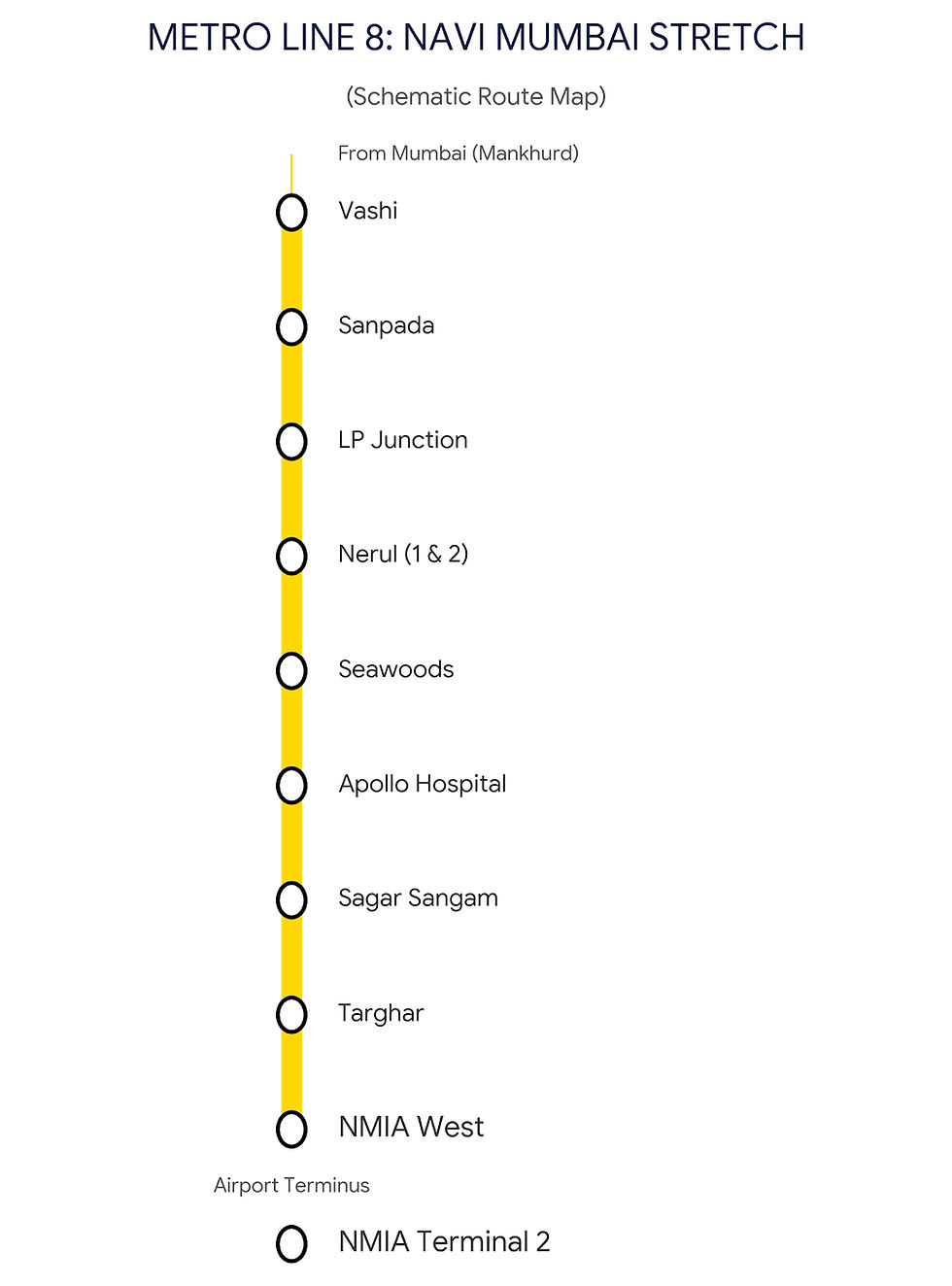
2.2 Geographic Significance

Metro Line 8 reshapes the geography of movement across Mumbai and Navi Mumbai. It doesn’t just connect two airports, it stitches together some of the region’s most important urban zones into a single, fluid transit spine.
A new continuous mobility corridor. The line creates an unbroken movement axis from central Mumbai all the way to Ulwe, dramatically improving east–west and north–south accessibility.
A boost for Harbour-line urban clusters key nodes along the Harbour belt—Vashi, Sanpada, Nerul, Seawoods, gain a powerful mobility upgrade, strengthening their role as commercial and residential hubs.
Catalyst for NMIA’s Airport Influence Zone (AIZ) by directly plugging into Targhar near Ulwe location, the corridor accelerates the development of the airport influence zone, unlocking new opportunities for real estate, business parks, and hospitality ecosystems.
Easing the load on choked transport arteries with a predictable, high-speed alternative in place, commuters can reduce reliance on SCLR, Eastern Express Highway, and the Vashi Bridge, easing pressure on some of Mumbai’s most congested routes.
3. REAL ESTATE IMPACT ASSESSMENT

Metro Line 8 is poised to become one of India’s most influential infrastructure catalysts, reshaping the economic and urban landscape of both Mumbai and Navi Mumbai. Its impact is expected to ripple far beyond faster airport connectivity—driving new waves of residential growth, unlocking commercial potential, and accelerating the rise of transit-oriented development corridors along its 34.89-km stretch.
By bringing previously disconnected zones into a seamless mobility network, the project is set to transform how people live, work, and move across the region, making it a pivotal force in the next decade of metropolitan development.
3.1 Mumbai Real Estate Impact
Kurla – LTT – Ghatkopar Belt
Becomes a multimodal powerhouse thanks to LTT + Metro Line 8
Strong potential for:
Redevelopment clusters
Premium rentals
Grade B to Grade A, commercial uplift
Mankhurd – Govandi – Baiganwadi
Traditionally underserved, these belts may see:
Higher redevelopment viability
Improved land valuation
Influx of workforce housing demand
3.2 Navi Mumbai Real Estate Impact

Vashi – Sanpada – Nerul – Seawoods - Belapur
Increased office absorption
Rise in rental & commercial values
Boost to retail centres and corporate campuses
Ulwe – Targhar – Sagar Sangam (NMIA Influence Zone)
This region is set to gain the maximum real-estate acceleration, driven by:
Proximity to NMIA terminal stations
Better metro-road-airport integration
Surge in mid-premium housing
New aviation-linked commercial districts
Airport Terminal Nodes (NMIA West + Terminal 2)
Natural hotspots for:
Airport hotels
MRO/logistics facilities
Transit-oriented business parks
4. MACRO CITYWIDE IMPACT
4.1 Mobility Transformation
Metro Line 8 is set to redefine how Mumbai moves. By enabling a 30-minute, end-to-end airport connection, the corridor marks a major leap in the city’s transport evolution—something only a handful of global aviation hubs like Tokyo, Dubai, and Singapore currently enjoy.
This shift is more than a reduction in travel time; it represents a new era of predictable, congestion-free mobility in a city where commute durations can vary wildly with traffic. For business travellers, transit passengers, and daily commuters alike, the Gold Line introduces a level of speed, reliability, and convenience that can fundamentally reshape travel behaviour.
In effect, the corridor doesn’t just improve connectivity—it elevates Mumbai into the league of world cities with high-speed, multi-airport mobility ecosystems, supporting tourism, trade, and long-term economic competitiveness.
4.2 Congestion Reduction
Substantial easing expected on:
Eastern Express Highway
SCLR
Vashi–Mankhurd corridor
4.3 Economic & Aviation Boost
The project supports NMIA’s anticipated passenger flow and will:
Optimise passenger load between both airports
Encourage airline/airport-driven commerce
Shape new business districts in Navi Mumbai
5. DEVELOPMENT TIMELINE
Project Stage | Status |
DPR by CIDCO | Completed |
State Approvals | Granted |
Financial Model | PPP + VGF as per News18 |
Current Phase | Preparing for tendering |
Projected Operations | Linked to DPR forecasts shared via News18 |
CONCLUSION
Metro Line 8, Mumbai’s upcoming high-speed airport-to-airport metro corridor, is set to redefine how India’s financial capital moves, connects, and grows. With the project entering the tendering stage, the corridor from Kurla to Ulwe is primed for major real-estate appreciation, infrastructure growth, and transit-led development.
This metro line is not just a transport project, it is the backbone of Mumbai’s next decade of urban transformation.
*Disclaimer:
The information provided above is accurate to the best of our knowledge. However, we do not guarantee the accuracy of the information presented in this article. Readers are advised to verify the details independently.
This information is sourced from the News18 article, "Mumbai Set For High-Speed Airport-To-Airport Metro Link As Govt. Clears Rs 23,000-Crore Project," and all original rights and copyright remain with News18.


Good read for awareness and insight, content gives an overall update on Golden Corridor favouring investors to take decisions accordingly.